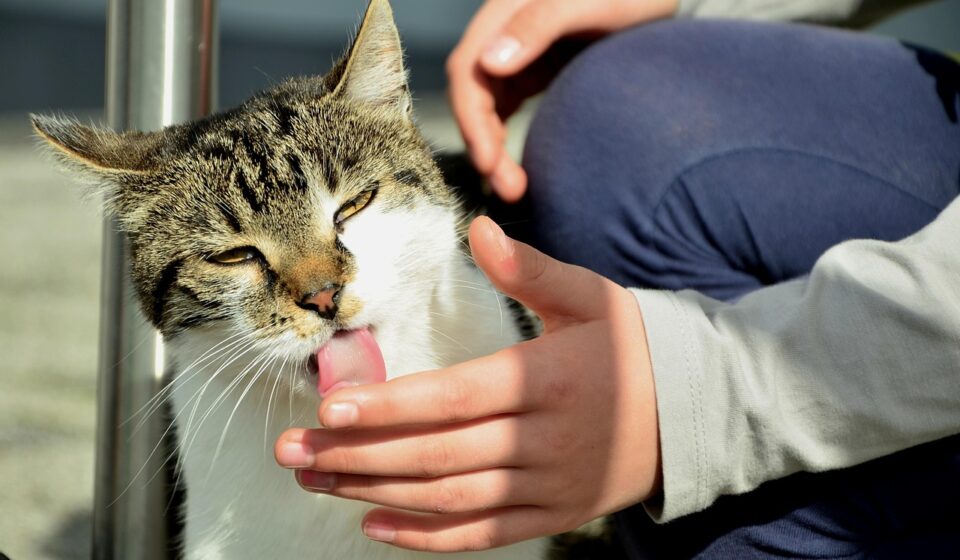
Your cat licks you to show affection, mark you as part of their family group, or sample the natural salts and oils on your skin. While it is often a sign of bonding, this behaviour can also be a subconscious response to stress or a way to get your attention when they feel ignored. Understanding why your cat licks you requires looking past the common myth that every lick is a “kiss”. While it is a sweet gesture, the feline motivation behind a rough, sandpaper tongue on your arm is often more practical—and sometimes more self-serving—than simple adoration.
The social bond of allogrooming
In the feline world, grooming is not just about keeping clean. When cats groom each other, it is called allogrooming. Mothers lick their kittens to clean them, comfort them, and establish a shared group scent. When your cat licks your hands, face, or arms, they are treating you as a member of their inner social circle. This behaviour reinforces your bond. By grooming you, your cat is mixing their scent with yours, which helps them feel secure in their environment. It is a sign of trust; a cat will not groom an animal or human they do not feel safe around. I view this as one of the ultimate compliments a cat can pay you, even if the physical sensation of their rough tongue is not particularly comfortable.
Marking you as territory
Cats are highly territorial animals that rely heavily on scent to understand their world. They have scent glands in various parts of their bodies, including their cheeks, paws, and lips. When your cat licks you, they are depositing tiny amounts of scent from their saliva onto your skin. This is essentially your cat claiming you. By leaving their scent on you, they are letting other animals know that you belong to their family group. If you have been out of the house and return smelling of the outside world, your cat may immediately start licking you to wash away those unfamiliar smells and re-establish their own familiar scent.
The appeal of sweaty or salty skin
Sometimes, the explanation is much simpler: you taste interesting. Human skin naturally produces sweat, which contains salt. Cats are often attracted to this salty taste, especially on your hands or arms after you have been active. Your cat might also be attracted to the scent of moisturizer, soap, or lotion you have recently applied. I recommend being cautious here. Many human skincare products, perfumes, and medicated creams contain ingredients that are toxic to cats. If your cat licks you after you have applied these products, it is best to gently move your arm away or wash the area to prevent them from ingesting harmful chemicals.
Anxiety and self-soothing
Licking releases endorphins in a cat’s brain. These feel-good hormones help soothe anxiety and reduce stress. If your cat is feeling anxious due to a change in the household—such as a new pet, a house move, or even rearranged furniture—they may turn to licking you as a comforting mechanism. This is similar to how a human might bite their nails when nervous. If the licking seems obsessive, urgent, or happens during specific stressful moments, it is likely an attempt to self-soothe. In these cases, look for other signs of stress, such as hiding, changes in litter tray habits, or overgrooming their own fur.
Why licking sometimes turns into a nip
Many cat owners experience a sudden shift where a peaceful grooming session ends with a sharp nip. This transition can be confusing, but it is usually a sign of overstimulation or a request for you to stop what you are doing. A cat’s tongue is covered in tiny, hook-like structures made of keratin, called papillae. These hooks are excellent for untangling fur and stripping meat from bones, but they can feel quite abrasive on human skin. If your cat licks you in the same spot for too long, the friction can cause discomfort or irritation. The subsequent bite is often a gentle warning—an instinctive “that is enough now” rather than an act of aggression. I find that watching your cat’s body language is the best way to prevent these nips. Look for warning signs of overstimulation, such as:
- A twitching or thumping tail
- Flattened or slightly turned-back ears
- A tense body posture
- Sudden rippling of the skin on their back
If you notice any of these signs, gently withdraw your hand before the bite occurs.
How to discourage excessive licking
If your cat’s sandpaper tongue is becoming painful or disruptive, you can gently train them to stop without damaging your bond. The key is to avoid punishing your cat, as they will not understand why you are angry about a behaviour they view as natural and positive. My advice is to use redirection and passive discouragement. When your cat starts licking you, try the following steps:
- Redirect their attention: Offer a favorite toy or a scratching post to divert their focus away from your skin.
- Walk away: If they persist, quietly stand up and move to another room. By removing yourself, you teach the cat that licking results in the end of social interaction.
- Provide alternative scent markers: Give your cat a soft blanket or a piece of your worn clothing that they can rub against or knead, satisfying their need to mix scents.
Consistency is vital. If you allow them to lick you sometimes but yell at them at other times, they will become confused and anxious, which may actually increase the behaviour.