The main distinction between the American Pit Bull Terrier and the Staffordshire Bull Terrier lies in their physical size and their legal status under UK law. The American Pit Bull Terrier is significantly taller and heavier, weighing between 15 and 27 kg, and is banned in the UK under Section 1 of the Dangerous Dogs Act 1991; conversely, the Staffordshire Bull Terrier is a smaller, fully legal, Kennel Club-registered breed weighing between 11 and 17 kg.
Beyond legal classifications, these two distinct breeds share a common ancestry originating from 19th-century British bull and terrier crosses. However, decades of selective breeding in different countries created two distinct dogs in size, physical proportions, and daily management needs. If you are trying to understand which breed is which, or navigating the legal landscape in the UK, understanding these specific structural and behavioral differences is essential.
Historical origins and breed development
Both breeds trace their lineage back to early 19th-century Great Britain, where breeders crossed Old English Bulldogs with various terriers to create agile, tenacious dogs used for baiting and pit sports. When these sports were outlawed under the Cruelty to Animals Act 1835, dog owners shifted focus toward show conformation and companion temperament, which led down two very different evolutionary paths.
In Great Britain, breeders refined the smaller variant into what became the official Staffordshire Bull Terrier. Recognized by The Kennel Club in 1935, the Staffy was deliberately bred for a compact frame and a famously affectionate nature toward human family members, earning it the longstanding nickname of the ‘nanny dog’.
Meanwhile, immigrants brought earlier bull and terrier stock to the United States during the 19th century. American breeders selected for larger frames, longer limbs, and greater working capacity, resulting in the American Pit Bull Terrier (APBT). The United Kennel Club (UKC) recognized the APBT in 1898, while the American Kennel Club (AKC) later registered a closely related variant known as the American Staffordshire Terrier (AmStaff). Today, I view these distinct historical goals as the primary reason why their body structures and international legal recognitions diverge so completely.
Physical comparison: height, weight, and proportions
When placed side by side, the physical differences in height, weight, and overall proportion between the American Pit Bull Terrier and the Staffordshire Bull Terrier are instantly noticeable. The American Pit Bull Terrier is a medium-to-large, lean, and athletic working dog, whereas the Staffordshire Bull Terrier is a small-to-medium, stocky, and low-slung companion dog.
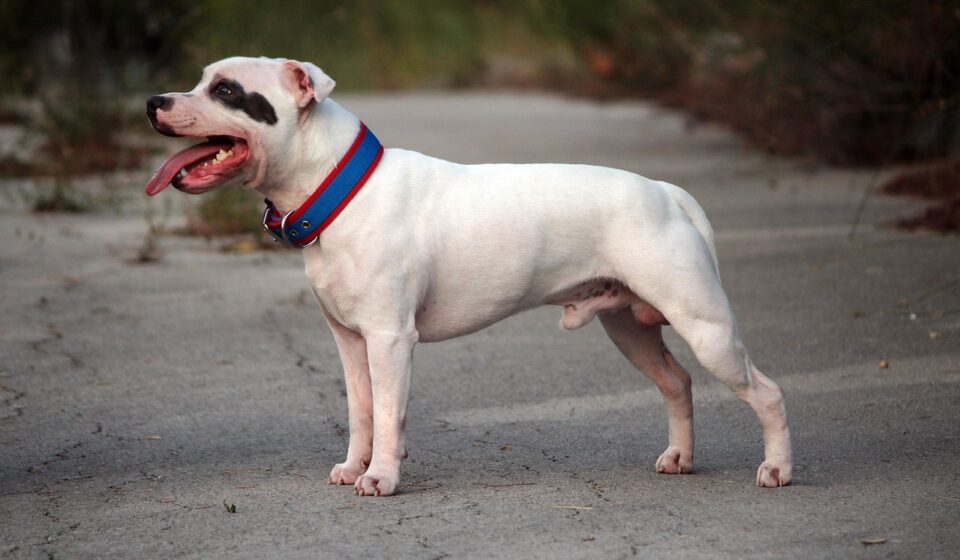
According to The Kennel Club breed standard, an adult Staffordshire Bull Terrier stands 36 to 41 cm (14 to 16 inches) at the shoulder. Desirable weight ranges from 13 to 17 kg (29 to 38 lbs) for males and 11 to 15 kg (24 to 34 lbs) for females. The head is short and deep with broad cranial development, distinct cheek muscles, a prominent stop, and a short muzzle measuring roughly one-third of the total head length.
In contrast, the United Kennel Club standard for the American Pit Bull Terrier specifies a shoulder height of 45 to 53 cm (18 to 21 inches) for males and 43 to 50 cm (17 to 20 inches) for females. Weight varies widely based on height and lean athletic build, typically ranging between 15 and 27 kg (35 to 60 lbs), though some working lines can be slightly larger. The head of an APBT is wedge-shaped when viewed from above, with a longer muzzle that accounts for roughly half the total head length, accompanied by a lean, muscular neck leading into a deep chest and a higher center of gravity.
Key structural and breed differences
The following criteria outline the primary differences between the Staffordshire Bull Terrier and the American Pit Bull Terrier.
| Feature | Staffordshire Bull Terrier | American Pit Bull Terrier |
|---|---|---|
| Height at Shoulder | 36 – 41 cm (14 – 16 inches) | 43 – 53 cm (17 – 21 inches) |
| Adult Weight | 11 – 17 kg (24 – 38 lbs) | 15 – 27 kg (35 – 60 lbs) |
| Head Structure | Short, deep skull, heavy cheek muscles, short muzzle | Medium-length skull, wedge-shaped, muzzle roughly half head length |
| Body Build | Stocky, muscular, short-coupled, low center of gravity | Lean, muscular, athletic, higher center of gravity |
| UK Kennel Club Recognition | Fully recognized (Gundog/Terrier Group) | Not recognized |
| UK Legal Status | Legal to own, breed, and sell | Banned under Section 1, Dangerous Dogs Act 1991 |
Temperament, exercise, and living needs
In terms of temperament toward humans, both breeds are renowned for their intelligence, intense loyalty, and desire for close human interaction. Neither breed makes a naturally good guard dog for property, as their inherent affection for people generally overrides protective instincts unless specifically trained or mishandled.
However, their exercise requirements and physical capabilities differ due to their size differences. An American Pit Bull Terrier requires substantial daily exercise—often 90 to 120 minutes of vigorous physical activity, including endurance running, agility, or structured tug work—to maintain mental health and prevent frustration. A Staffordshire Bull Terrier requires moderate daily activity, typically around 45 to 60 minutes of structured walking paired with interactive play and scent games.
Both breeds can exhibit dog selectivity or dog aggression if socialisation and management are neglected. This is a crucial consideration for potential owners: while both breeds can live peacefully in multi-pet homes with dedicated socialisation, neither should be expected to be naturally sociable with strange dogs in off-leash park settings. I always recommend planning for structured leash walks and secure garden spaces regardless of which bull breed you care for.
The UK legal landscape and the Dangerous Dogs Act 1991
In the United Kingdom, understanding the legal framework surrounding bull breeds is a fundamental safety and legal responsibility. Under Section 1 of the Dangerous Dogs Act 1991 (DDA), it is illegal to own, breed, sell, exchange, or advertise four specific types of dogs, including any dog ‘of the type known as the Pit Bull Terrier’. Later additions, such as the XL Bully ban introduced under the same framework, further restrict pit bull-type dogs.
Crucially, the DDA applies to physical ‘type’ rather than official pedigree documentation. Dog Legislation Officers (DLOs) evaluate a dog using a physical standard issued by the Department for Environment, Food and Rural Affairs (DEFRA). If a dog substantially matches the physical measurements and morphological characteristics listed in the DEFRA guide—such as tall height, long muzzle, deep chest, and high muscle mass—it can be seized and declared a pit bull type by a magistrates’ court, regardless of whether its parents were registered Staffordshire Bull Terriers.
The Staffordshire Bull Terrier itself is explicitly legal in the UK. However, crossbreeds or poorly bred, oversized ‘Staffies’ that lack pedigree papers can sometimes fall into legal ambiguity if their measurements approach the DEFRA Pit Bull type description. If a court determines a dog is a Pit Bull type, the owner must apply for an Exemption Order through the Index of Exempted Dogs. Exemption requires proving the dog is not a danger to public safety, having the dog neutered, microchipped, insured, and keeping it muzzled and on a lead in all public places at all times.
How to safely identify and safeguard your dog in the UK
If you live in the UK and own or plan to acquire a Staffordshire Bull Terrier, taking specific precautions protects both your pet and yourself from legal misidentification under the Dangerous Dogs Act.
-
- Obtain verifiable pedigree paperwork: Buy from reputable breeders registered with The Kennel Club. Formal registration documents and five-generation pedigree certificates provide clear evidence of your dog’s true heritage if questions ever arise.
- Keep your dog within standard physical bounds: Avoid purchasing advertised ‘giant Staffies’ or ‘bullpit crosses’. Breeders offering oversized bull breeds are often crossing Staffordshire Bull Terriers with American Pit Bull Terriers or American Bulldogs, producing offspring that easily meet DEFRA’s prohibited physical standard.
- Maintain mandatory compliance: Ensure your dog is microchipped with your current contact details and wearing a collar tag displaying your name and address in public spaces, as required under the Microchipping of Cats and Dogs Regulations and the Control of Dogs Order 1992.
- Invest in early socialisation and training: Well-mannered, quiet dogs on a lead rarely draw negative attention. Early obedience training prevents reactivity toward other animals, reducing any potential complaints from neighbors or authorities.
This advice is not suitable for individuals seeking an off-leash dog park companion or those unwilling to maintain strict management around other animals. Bull breeds require committed owners who prioritize safety, structure, and positive reinforcement training over trends or status symbols.
Related guides
Sources: Staffordshire Bull Terrier Dog Breed Information
Frequently asked questions
Is an American Pit Bull Terrier the same as a Staffordshire Bull Terrier?
No, they are distinct breeds with different origin histories, body sizes, and breed standards. The American Pit Bull Terrier is taller and heavier (15–27 kg), while the Staffordshire Bull Terrier is a smaller UK breed (11–17 kg) recognized by The Kennel Club.
Are Staffordshire Bull Terriers illegal in the UK?
No, Staffordshire Bull Terriers are completely legal to own, breed, and buy in the United Kingdom. However, oversized crosses that meet the physical description of a Pit Bull Terrier type under the Dangerous Dogs Act 1991 can face legal scrutiny.
What is the size difference between a Staffy and a Pit Bull?
A Staffordshire Bull Terrier stands 36 to 41 cm tall and weighs 11 to 17 kg. An American Pit Bull Terrier stands 43 to 53 cm tall and weighs 15 to 27 kg, making the Pit Bull noticeably taller, longer, and heavier.
Can a Staffy cross be mistaken for a Pit Bull under UK law?
Yes, because the Dangerous Dogs Act assesses dogs based on physical appearance and measurements rather than DNA or breed papers. An oversized Staffordshire Bull Terrier cross with a longer muzzle and tall legs may meet the DEFRA physical standard for a prohibited pit bull type.