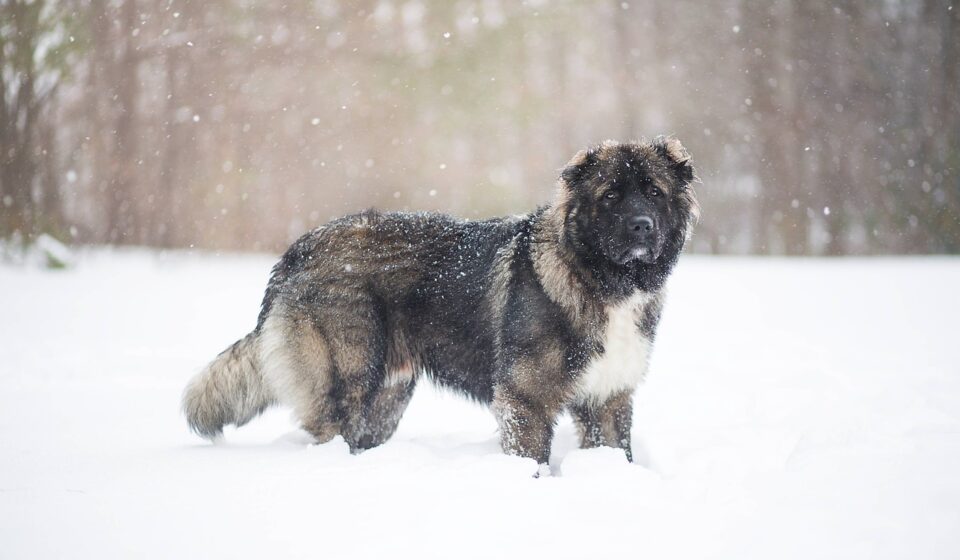
The dog breed caucasian ovcharka, also known as the Caucasian Shepherd Dog, is a massive guardian dog breed from the Caucasus region. Originally bred to protect livestock from predators, this deeply loyal yet fiercely protective breed requires experienced handling, secure space, and extensive early socialisation.
For centuries, pastoral communities across Georgia, Armenia, Azerbaijan, and Dagestan relied on these formidable dogs to guard sheep herds against wolves, bears, and intruders. That historical purpose remains hardwired into the breed today. They are not typical domestic pets, and understanding their instinctual drives is essential before considering bringing one home.
What physical traits define the Caucasian Ovcharka?
The Caucasian Ovcharka is among the largest and most powerful guardian breeds in the canine world. Male dogs typically stand between 72 cm and 75 cm or higher at the shoulder and weigh upwards of 50 to 70 kg, while females are slightly smaller but equally imposing. Their bone structure is dense, muscular, and built for harsh climates and physically demanding terrain.
Their coat varies in length, classified generally into long-haired, medium, and short-haired varieties. All three coat types feature a dense, weather-resistant double coat designed to protect the dog against severe weather and physical attack. Grooming requirements are significant: the thick undercoat sheds heavily, requiring thorough brushing at least twice a week to prevent severe matting, particularly behind the ears and around the thighs.
| Trait / Variety | Mountain Type (Long-Coated) | Steppe Type (Short-Coated) |
|---|---|---|
| Coat Structure | Long guard hairs with a distinct neck mane and heavy tail/thigh feathering | Short, dense outer coat with a thick woolly undercoat and no mane |
| Body Build | Heavier bone structure, compact body, and massive skull size | Slightly longer legs, lighter frame, and higher heat tolerance |
| Grooming Frequency | 3 to 4 times weekly; daily during seasonal coat shedding | 1 to 2 times weekly; daily during seasonal coat shedding |
Essential grooming maintenance steps
- Line Brushing: Part the thick double coat down to the skin with one hand and brush outward in sections using a long-pinned slicker brush or undercoat rake.
- Mat Inspection: Check high-friction zones daily, including the skin behind the ears, armpits, inner thighs, and sanitary areas under the tail.
- Coat Blowing Management: During spring and autumn shedding periods, use a high-velocity dog dryer to loosen trapped undercoat before brushing to prevent skin moisture buildup and hot spots.
How does the Caucasian Ovcharka behave?
A Caucasian Ovcharka’s primary instinct is territory defense and livestock or family protection. Unlike herding breeds that take continuous direction from a human handler, this guardian breed was selectively bred to assess threats and act independently without waiting for commands.
With their immediate family, Caucasian Ovcharkas are surprisingly gentle, calm, and affectionate. However, towards strangers, unusual noises, or unfamiliar animals entering their defined space, their default reaction is suspicion and defensive posture. They do not welcome unannounced visitors, parcel delivery workers, or loose dogs near their home. I view this breed as one of the most serious working guardians available, meaning their protective drive cannot simply be trained out of them.
The guardian threat assessment loop
- Observation Phase: The dog selects an elevated or central vantage point on the property to monitor boundaries passively.
- Alert Signaling: Upon detecting an intrusion or perimeter change, the dog positions itself between the threat and its territory, issuing a low, resonant warning bark.
- Deterrence Posturing: If the trigger approaches, the dog raises its hackles, stiffens its posture, and shifts to direct, uninterrupted eye contact.
- Physical Interception: If the warning is ignored, the dog moves to actively block, physically check, or neutralize the perceived intruder without hesitation.
Who should—and should not—own a Caucasian Ovcharka?
This is emphatically not a dog for first-time owners, nor is it suitable for high-density suburban settings, flat living, or households with frequent social gatherings. Managing a dog of this size and territorial intent requires physical strength, confidence, and complete control of the home environment.
A suitable owner needs a quiet, rural or semi-rural property with tall, exceptionally sturdy fencing. Fencing must be physically capable of containing a dog that easily exceeds 60 kg and possesses intense territorial drives. I strongly advise against attempting to keep this breed in a typical suburban garden where people or other dogs pass close to the perimeter on a daily basis, as constant boundary frustration can lead to chronic stress and fence aggression.
Property security and setup requirements
- Fencing Height and Strength: Minimum height of 1.8 metres (6 feet) constructed from heavy-gauge chain link, solid wood panels, or reinforced masonry.
- Dig Prevention: Perimeter base buried at least 30 cm underground or secured with concrete footers to stop digging beneath fence lines.
- Air-Lock Entry Gates: Double-gate entrance systems that prevent the dog from slip-escaping or confronting visitors directly when an exterior gate opens.
- Visual Barriers: Privacy slats or solid fencing panels to eliminate sightlines to passing street traffic, reducing reactive barking loops.
Who this advice does not suit
- Urban apartment tenants or residential renters without control over permanent property fencing.
- Families who host frequent social parties, children’s playgroups, or unannounced domestic help.
- Handlers seeking an off-leash park dog, casual walking companion, or dog-cafe social pet.
- Owners unable or unwilling to handle a dog weighing upwards of 60 to 70 kg on lead.
What socialisation and training does this breed require?
Socialisation for a Caucasian Ovcharka puppy must start early and continue consistently throughout its development. The goal of socialisation with a working guardian is not to turn the dog into an overly outgoing social pet, but rather to teach it to remain calm and indifferent to neutral strangers and novel environments.
Training must rely on calm, clear consistency and strong structure. Harsh physical punishment or dominance-based methods can severely damage the handler-dog relationship and provoke dangerous defensive responses in a dog of this power. Positive reinforcement paired with firm, unambiguous boundaries yields the best results. Early lead training is critical, as controlling an unsophisticated, untrained 60-kg adult dog on a lead is extremely difficult.
Worked example: Building leash neutrality step-by-step
- Determine Threshold Distance: Identify the distance (e.g., 25 metres) at which the young dog notices a stranger or another dog but remains calm enough to accept food rewards.
- Mark Visual Engagement: Allow the dog to observe the trigger for 2 seconds, mark the calm visual observation with a clicker or reward word, and immediately deliver a high-value treat.
- Execute Directional Pivots: Before the dog reaches emotional arousal or physical tension, deliver a clear direction word (“Turn”) and pivot 180 degrees away from the trigger.
- Reinforce Loose-Leash Movement: Reward generously with high-value food whenever the dog turns back to match your walking pace without pulling against the harness.
Common behavioural problems and fixes
- Problem: Perimeter Fence Charging.
Fix: Restrict unsupervised garden access. Install an interior secondary fence line 1.5 metres back from the main boundary to remove direct contact with passersby. - Problem: Leash Opposition and Pulling.
Fix: Use a heavy-duty, dual-clip harness attached at both the chest and back rings. Practise immediate directional changes inside the house and yard before moving to public roads. - Problem: Territorial Guarding of Feeding Zones.
Fix: Feed the dog in a private, quiet room or secure crate where human foot traffic is blocked. Never attempt to take food away by force; establish trade routines using higher-value rewards early in puppyhood.
What health considerations affect the breed?
Like many giant breeds, the Caucasian Ovcharka is subject to specific structural and deep-chested health vulnerabilities. Their rapid growth rate during puppyhood requires strict diet monitoring to ensure bone and joint development proceed at a safe pace.
- Hip and Elbow Dysplasia: Joint malformation is common in large breeds, making health testing of parent dogs crucial before purchasing a puppy. Ensure parents have certified joint evaluations (such as OFA or PennHIP).
- Gastric Torsion (Bloat): Due to their deep chest, they are at risk for life-threatening stomach twisting. Feeding smaller, split meals and avoiding heavy exertion immediately after eating helps manage this risk.
- Entropion and Ectropion: Eye condition issues where eyelids roll inward or outward can cause chronic irritation, corneal damage, and recurring infections requiring surgical correction.
- Growth Plate Stress: Oversized calcium supplementation or excessive early high-impact exercise (jumping or hard running before 18 months) can permanently damage unclosed bone growth plates.
Nutritional guidelines for giant breed development
Puppies should consume specialised large– or giant-breed formulas with controlled energy density and precise calcium-to-phosphorus ratios (typically between 1.1:1 and 1.3:1). Keeping growing puppies lean reduces mechanical strain on developing skeletal structures, lowering the long-term risk of hip and elbow degeneration.
Related guides
Sources: Caucasian Shepherd Dog, Caucasian Shepherd Dog
Frequently asked questions
Is the Caucasian Ovcharka good with family children?
A Caucasian Ovcharka is typically tolerant and protective towards children within its own immediate family when raised alongside them. However, close supervision is mandatory, as the dog may misinterpret rough play between family children and visiting friends as an attack and attempt to intervene defensively.
How much food does a Caucasian Ovcharka eat daily?
An adult Caucasian Ovcharka consumes a substantial amount of food, often requiring between 4 to 6 cups of high-quality, large-breed adult dog food per day depending on their activity level and weight. Controlled caloric intake during puppyhood is vital to prevent unnaturally fast bone growth.
Can a Caucasian Ovcharka live in an apartment?
No, a Caucasian Ovcharka is entirely unsuited to apartment or flat living. Their high territorial vigilance, large physical footprint, and loud protective bark require a spacious environment with high, secure fencing.
Is a Caucasian Ovcharka aggressive by nature?
The Caucasian Ovcharka is naturally aloof, highly suspicious of strangers, and intensely territorial rather than randomly aggressive. However, without proper early socialisation, clear boundaries, and secure containment, those protective instincts can easily manifest as dangerous territorial aggression.
How much daily exercise does a Caucasian Ovcharka need?
An adult Caucasian Ovcharka requires moderate daily exercise, typically around 45 to 60 minutes of low-impact walking alongside secure perimeter patrolling. They are built for endurance and vigilance rather than high-speed sports, and high-impact activities like jumping or agility should be avoided to protect their heavy joint structure.